
How to Plan a Family Gap Year: A Complete Guide From a Family Who’s Actually Doing It
We are the Schulkins - Levi, Kia, Maddison (10), and Emmett (8). In 2025 we packed up our home in Brisbane, Australia and left for a year of slow travel around the world. Not because we had it all figured out. Because we didn’t want to look back and wonder what if.
This guide is everything we wish we’d had before we left. It’s not theory. It’s what we actually did, what broke, what worked, and what we’d change.
If you’re thinking about taking a family gap year, start here.
What Is a Family Gap Year?
A family gap year is when a family, typically with school-age kids, takes an extended break from the usual routine to travel, explore, and experience life differently. It can be one year, six months, or two years. There’s no fixed definition.
The version most families end up choosing looks something like this: you pause work (or work remotely), pull the kids from school (or continue their education on the road through worldschooling), and spend an extended period moving slowly through the world.
It’s not a holiday. It’s a different way of living, for a defined period of time.
Is a Family Gap Year Right for You?
Before you start planning, it’s worth asking honestly whether long-term family travel is actually what your family wants… and needs.
Signs it might be right for you:
- You’ve had the conversation more than once and it keeps coming back
- At least one parent can work remotely, has savings, or has a sabbatical option
- Your kids are school-age but not mid-way through a critical exam year
- You’re drawn to slower, more intentional living, not just a longer holiday
- You’re okay with uncertainty and improvisation
Signs to think carefully first:
- You’re running away from something specific (relationship problems, work burnout alone) travel won’t fix those
- Your kids have complex medical or support needs that would be hard to manage on the road
- One partner is genuinely not on board, this works best as a team decision
- You haven’t thought through the financial side at all yet
There’s no perfect time and no perfect family. But it’s worth being honest with yourself before you get too far into the planning.
Step 1: Get Everyone on the Same Page
The single most common reason family gap years fall apart before they start is that the adults aren’t truly aligned. One person is excited and one person is anxious. That’s normal. What’s not okay is pretending the anxiety isn’t there.
Have the real conversations early:
- Why do we want to do this? What are we hoping will change or happen?
- What are we each most worried about?
- What does success look like for this trip?
- What would make us cut it short without feeling like we failed?
- Do the kids know what this actually means? (Not just “we’re going travelling” but “you’ll leave your friends, your school, your bedroom”)
Include your kids in the conversation. They don’t get veto power, but they deserve to understand what’s happening and feel like their feelings matter. Maddison and Emmett both had mixed feelings before we left. Acknowledging that honestly made the transition much easier than pretending it was all exciting.
Step 2: Work Out Your Timeline
How long are you going? This matters for almost every decision that follows.
Common options:
- 3–6 months: Easier to manage financially and logistically. Feels more like an extended holiday than a life reset, but still genuinely transformative.
- 6–12 months: The sweet spot for most families. Long enough to settle into a rhythm, develop worldschooling routines, and truly experience places rather than race through them.
- 12+ months: A bigger commitment, financially, professionally, and emotionally. But also where the deepest changes tend to happen.
We planned for twelve months. Our advice: pick a timeframe that feels slightly uncomfortable but achievable, and build in flexibility. You can always extend if things are going well and come home early if you need to. Don’t lock yourself into anything that can’t bend.
Step 3: Figure Out the Money
This is what stops most families. They assume it’s impossible without being very wealthy. In our experience, that’s not true, but you do need to plan carefully.
How Much Does a Family Gap Year Actually Cost?
This depends enormously on where you go, how you travel, and what lifestyle you maintain. There’s no universal number. But here’s a realistic framework.
What drives cost up:
- Western Europe, United Kingdom and Scandinavia
- Frequent flights and fast-moving itineraries
- Hotels instead of apartments or longer-term rentals
- Eating out at tourist restaurants
- Lots of paid activities and excursions
- School holiday periods
What drives cost down:
- Southeast Asia, Central America, Eastern Europe
- Slow travel (fewer flights, lower weekly accommodation rates)
- Cooking some meals at home via apartments
- Living like a local rather than a tourist
- Travelling outside peak periods
Our budget: We built a $10,000 AUD/month budget for a family of four. That works out to roughly $120,000 AUD for the year, or about $75,000–80,000 USD. It sounds like a lot but it includes absolutely everything: accommodation, food, transport, activities, insurance, and unexpected costs.
In cheaper regions like Vietnam, we came in well under budget. In Europe (especially ski season in Austria), we spent more. It averaged out.
→ Read our full pre-departure budget breakdown
Where Does the Money Come From?
Most families fund a gap year through one or more of:
- Savings built specifically for this — the most common approach. Many families spend 2–5 years saving before going.
- Selling or renting the family home — renting your home while you travel can cover a significant chunk of your costs.
- Remote work — one or both parents working while travelling. This changes the trip significantly (you need reliable internet and a real schedule), but it’s increasingly viable.
- Sabbaticals — some employers offer unpaid leave for extended periods. More common in certain industries and countries than others.
- Redundancy or career break — some families use a job change as the catalyst.
We used a combination of savings and remote work. Be honest about what your real monthly burn rate will be, and add 15–20% as a buffer for the unexpected. There will always be unexpected.
Step 4: Plan Your Route (Loosely)
The biggest mistake families make is over-planning. You don’t need to know where you’ll be on week 34. You need a starting point, a rough direction, and a few anchor points.
What to nail down before you leave:
- First destination (where you’ll land and decompress)
- First 4–6 weeks of accommodation (so you’re not stressed from day one)
- Any flights that need to be booked far in advance (peak season, unusual routes)
- Visa requirements for your first few countries
What to leave flexible:
- Specific towns within regions
- Exact duration in each place
- Countries beyond the first 2–3 months
The slow travel principle: We spend weeks or months in places rather than days. This is not only cheaper, it’s genuinely better for kids. They settle in. They find routines. They make friends. A week in Rome is a holiday. A month in Sicily starts to feel like something else entirely.
Think in regions, not a checklist of cities. Southeast Asia is a great starting region: affordable, family-friendly, easy logistics, extraordinary food, and manageable travel distances. Europe is expensive but rich with history and culture. Central America is underrated for families. Wherever you start, give yourself permission to stay longer than planned if it’s working.
Step 5: Sort Out the Practicalities
There’s a lot to do before you leave. Here’s the framework. Not every item will apply to your situation.
Visas
Research visa requirements for every country you plan to visit, for your specific citizenship. Some countries require visas in advance; others offer visa-on-arrival or e-visas. Know your limits, especially if you have children on separate passports from parents.
Travel Insurance
Non-negotiable. Get comprehensive family travel insurance that covers medical emergencies, evacuation, trip cancellation, and any adventure activities you plan to do. Read the fine print on pre-existing conditions and extreme sports. We use this for peace of mind more than anything.
Health
Visit your GP and a travel medicine clinic at least 6–8 weeks before departure. Discuss vaccinations for your destinations, anti-malarials if relevant, and get prescriptions for any regular medications you’ll need. Dental checks before you go. Nobody wants a dental emergency in a country where they don’t speak the language.
What to Do With Your Home
Options: sell, rent, or have someone look after it. Each has implications for your finances, your taxes, and your sense of security. Many families rent their home and use the income to offset travel costs. Think carefully about what you’re comfortable with.
School
If your children are school-age, you’ll need to formally notify your school and understand your legal obligations. In Australia, you apply to be registered as a home educator with your state authority. Requirements vary by state. Research this well in advance. It’s generally straightforward but has lead times.
→ Read our worldschooling guide
Banking and Money
Set up accounts with low or no international transaction fees before you leave. Have multiple cards across different accounts. Let your bank know you’ll be travelling. Look into services like Wise for transferring money internationally.
What to Pack
Less than you think. We packed for four people across multiple seasons. The key principle: if you can buy it there, don’t pack it. Heavy bags make every travel day harder than it needs to be. We learnt some significant lessons in this space.
Step 6: Understand Worldschooling
If your kids are school-age, education is the question everyone will ask you about. And honestly, it was the thing we were most worried about before we left.
The short version: it works. But it takes time to find your rhythm.
What Worldschooling Actually Is
Worldschooling is educating your children while travelling. It’s not the same as homeschooling (though it uses similar methods). It’s not unschooling (though it draws on that philosophy). It’s combining structured learning with the extraordinary real-world education that comes from living in different countries, cultures, and environments.
The world itself becomes the classroom. Your children learn geography by being there. They learn about money by handling it in different currencies. They learn resilience by navigating change. They learn empathy by meeting people whose lives look nothing like theirs.
But they also need to learn to read, write, and do maths. Don’t let anyone tell you the world takes care of that by itself.
What We Got Wrong (And What Finally Worked)
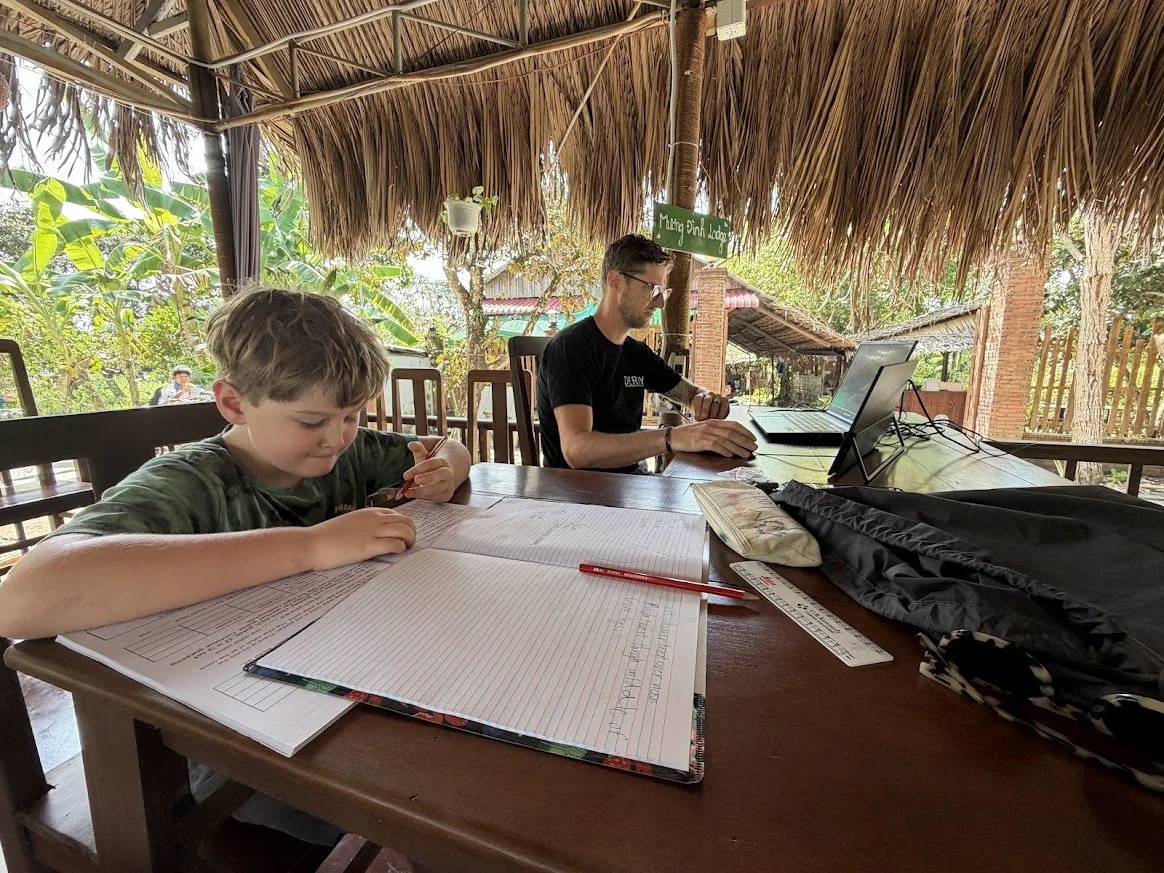
We started with workbooks from home. The kids weren’t engaged. Then we switched to apps and tablets. Looked like it was working, until we realised they were clicking through without understanding anything, and the screen time was affecting their focus and creativity.
The turning point: we stripped it back. Short, focused sessions. Sitting with them. Actually teaching. No screens for school.
It works far better. Ten focused minutes is worth more than an hour of clicking through an app.
→ Read the full story of how we found our worldschooling rhythm
The Legal Side
In Australia, the legal requirements for educating your children outside of school vary by state. Most states require you to be registered as a home educator and to demonstrate that your children are receiving instruction across key learning areas. The process is generally straightforward and the requirements are reasonable. Contact your state education authority well before you depart.
Step 7: Prepare Your Kids
Kids are far more adaptable than adults give them credit for. But preparation matters.
Be honest about what’s changing. They’re leaving their friends, their school, their routines, and their bedroom. That’s a lot. Acknowledge it. Don’t oversell the adventure.
Involve them in the planning. Let them pick one destination they’re excited about. Let them choose what goes in their own backpack. Give them some ownership over something.
Talk about the hard parts. Loneliness is real. Missing friends is real. Bad travel days are real. Kids who know to expect hard moments handle them better than kids who were only told it would be amazing.
Build excitement around specific things, not just “it’ll be amazing!” but “in Vietnam we might ride a scooter through rice fields” or “in Austria we could learn to ski.”
Our kids were nervous and excited in roughly equal parts when we left. Now, months in, they’re some of the strongest advocates for this trip. But that took time. Don’t expect instant enthusiasm.
Step 8: Manage the Emotional Reality
Nobody talks about this enough, and it’s one of the most important parts.
Long-term family travel is not the permanent holiday it can look like from the outside. It’s real life, lived in unusual places. And real life has hard days, tired kids, arguments, homesickness, and moments where everyone just wants something familiar.
What we’ve found:
- The first few weeks are often the hardest, everything is new, nothing is routine, and the novelty hasn’t set in yet
- Having a routine matters enormously, especially for kids
- You need to build in rest, not every day needs to be an adventure
- Parents need to check in with each other honestly, not just put on a brave face
- Connection with home matters, regular video calls with grandparents and friends are worth scheduling
→ Read: The Hardest Parts of Travelling the World as a Family
Step 9: Build Your Rhythm on the Road
The families who struggle most are the ones who try to travel the way they holiday, fast, full, and packed with things to see and do. The families who thrive tend to slow down.
What a good rhythm looks like for us:
- Wake without an alarm (mostly)
- Morning school session: 1–1.5 hours for the kids, one parent teaching
- Lunch out at a local café or market
- Afternoon exploring, activities, or just wandering
- Home for dinner most nights, cooking or local takeaway
- Evenings are family time: reading, board games, movies
We don’t try to see everything in every city. We pick a few things that matter and we show up unhurried. The kids explore, we have coffee, and something unexpected usually happens that becomes the actual memory.
→ Read: What Our Days Look Like Now
Common Questions
Do you need to be wealthy to do this?
No. You need savings, a plan, and a willingness to travel slowly and live simply. Plenty of families do this on $5,000–6,000 AUD/month by focusing on affordable regions and long-stay accommodation. It requires financial discipline, but wealth is not a prerequisite.
What about my career?
Depends on your field. Remote work has made this significantly more viable than it was five years ago. Some people take sabbaticals. Others deliberately use this as a career transition point. It’s worth thinking about what you want to return to before you leave.
Won’t my kids fall behind at school?
Possibly, in some academic areas, especially if they’re in the middle of formal curriculum years. But many families find that what their children gain; confidence, resilience, curiosity, communication skills, genuine worldliness, more than compensates. It’s also reversible: kids who return to school generally catch up within a few months in any areas where they’ve slipped.
How do you handle healthcare?
Good travel insurance plus common sense. We research the quality of healthcare in each destination before we go. We carry a well-stocked first aid kit. We’ve dealt with minor illness and injury on the road without any serious problems. Telehealth services are increasingly available globally.
What do you tell people who think you’re crazy?
We stopped needing to justify it. The people who ask with genuine curiosity, we tell them honestly. The people who make comments with judgment behind them, they’re usually wrestling with their own sense of what’s possible. That’s not our problem to solve.
The One Thing Nobody Tells You
It changes you. Not in a dramatic, overnight way. Slowly. You start to notice what you actually need versus what you thought you needed. You get better at being present. You watch your kids become more adaptable, more curious, more confident in themselves.
You won’t come back the same people. You’ll come back knowing what matters.
That’s not why we left. But it’s the thing we’re most grateful for.
Ready to Go Deeper?
- Why we left — the full story
- Our $10,000/month budget plan
- What we packed for four people
Running Wild Together is the travel journal of Levi, Kia, Maddison, and Emmett Schulkins, a family of four from Brisbane, Australia, travelling the world slowly and sharing what it’s actually like. Follow along on Instagram or YouTube.